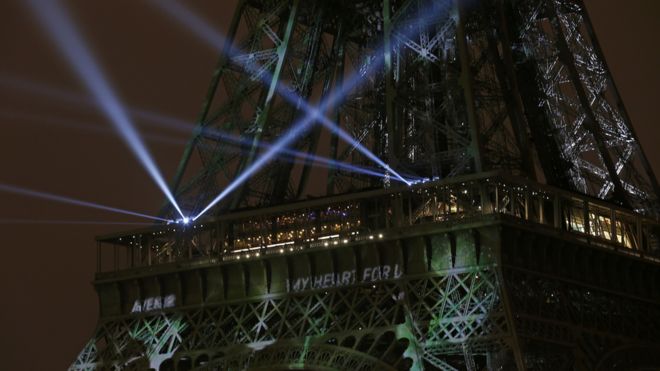
The Eiffel Tower was lit up on Sunday evening in support of the climate conference
A critical UN conference aimed at agreeing a new global approach to climate change has begun in Paris.
Negotiators from 195 countries will try to reach a deal within two weeks aimed at reducing global carbon emissions.
Leaders from 147 nations will address the meeting, known as COP21, on Monday. Initiatives aimed at boosting clean technologies are due to be launched.
But the world's poorest countries say they fear being "left behind" in the push for a new treaty.
The French government will officially take over the running of the talks during Monday's opening ceremony.
Police have locked down the conference centre in Le Bourget, closing roads amid strict security for the leaders' visit.
Presidents and prime ministers will address the gathering with organisers hoping high-level appearances will boost the chances of reaching a deal to cut emissions.
"It will be the turning point, which is what the world requires," said French Foreign Minister Laurent Fabius at the weekend.
Boost for clean energy
World leaders including President Obama and David Cameron are due to attend the talks. The leaders, who will only stay at the meeting for one day, are likely to make a number of significant announcements.
Under one plan called Mission Innovation, a group of 20 countries - including the US, France and India - will seek to double their investment in clean-energy research over five years.
Private individuals including Bill Gates and Facebook founder Mark Zuckerberg will also invest into low-cost, clean-energy projects, every year from 2020.
In another initiative, France and India will announce a global alliance that aims to bring together 100 solar-rich countries in tropical regions to rapidly expand the availability of electricity from the Sun.
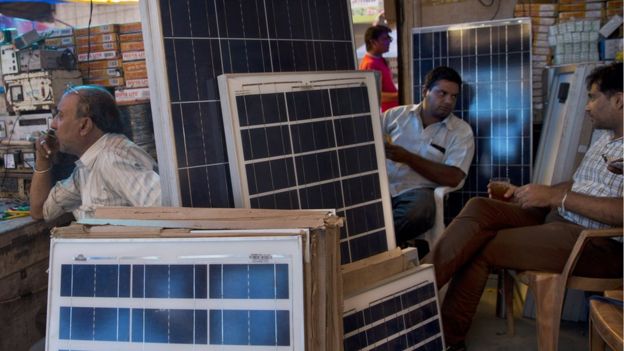
India is planning to be part of a new drive for solar energy
Meanwhile a number of European nations, working with the World Bank, announced a $500m fund designed to help developing countries cut their carbon emissions. Germany, Norway, Sweden, and Switzerland are backing what's termed the Transformative Carbon Asset Facility.
This will measure and pay for emission cuts in areas like renewable energy, transport, energy efficiency, solid waste management, and low carbon cities. According to the World Bank it could make payments for carbon cuts to countries that remove fossil fuel subsidies.
'Catastrophic' temperature rise
But among the warm words and good intentions, there are growing concerns among the very poorest countries that their interests might be sacrificed in the clamour for compromise.
Most of the discussions here will revolve around a new deal that would limit global warming to 2C.
Assessments of the more than 180 national plans that have been submitted by countries suggest that if they were implemented the world would see a rise of nearer to 3C.
UN climate conference 30 Nov - 11 Dec 2015

COP 21 - the 21st session of the Conference of the Parties - will see more than 190 nations gather in Paris to discuss a possible new global agreement on climate change, aimed at reducing greenhouse gas emissions to avoid the threat of dangerous warming due to human activities.
However, the 48 members of the least developed countries (LDC) group at these talks say that for them, anything more than 1.5 degrees would be catastrophic.
"For the LDCs, economic development, regional food security, ecosystems, and the very survival of their populations and livelihoods are at risk if talks aim only for a 2C world," said Giza Gaspar Martins from Angola.
"The heads of state will be in Paris to set the tone for the negotiations. We renew our call for an ambitious, robust and binding climate deal that does not leave behind the most vulnerable among us."
While the arrival of the leaders will give a significant boost to the conference, the practical difficulties of securing a deal have not gone away.
At present the negotiating text runs to more than 50 dense pages, filled with brackets, indicating disagreement.
The hope is that, by the end of this week, a new draft agreement will be ready for environment ministers to haggle over during the second half of the conference.
Among those attending the talks is the broadcaster and naturalist Sir David Attenborough. He said he was not confident that the Paris talks would produce a deal to tackle the "hideous problem" of climate change.
"We know the consequences of rise of temperature, what it will do for the oceans, for example," he told the BBC.
"Increasing temperature of the oceans will cause havoc amongst the fish stocks and similarly increasing the temperature of the Earth is causing the spread of deserts.
"The problems of a rise in temperatures are huge; it has to be avoided at all costs."

No comments:
Post a Comment