In Nigeria, as a result of its high prevalence and personal, social and economic implications which go beyond childlessness, inability to bear children is a social and psychological stigma. Culturally, womanhood is defined through motherhood, and infertile women usually carry the blame for a couple’s inability to conceive. Infertile women are frequently stigmatized, leading to isolation, neglect, domestic violence and sometimes polygamy.
So when a number of Nigerian couples attempted to conceive in the bedroom but failed, it was the women who took initiative to try the laboratory. After running from pillar to post for several years, one by one, along with their spouses, they went through technologically advanced but time-tested Assisted Reproductive Technology, ART, initiatives such as Invitro Fertilization or IVF, and Intra Cytoplasmic Sperm Injection, ICSI, among others.
In the end, science and technology triumphed where nature failed and all the couples are blessed with their own biological children. The women are elated and fulfilled. They want to share their stories and let the world to know there is solution to infertility.
Aspiring to motherhood
A few of them got together to form an advocacy group aimed at encouraging
and enabling other infertility challenged couples to seek qualitative assistance from reputable ART centers in Nigeria.
The group, known as the Association for the Prevention of Infertility and Promotion of Reproductive Health and Rights, ASPIRE, is currently on a crusade to stop the stigma and break the silence surrounding infertility, and also drive the need for effective treatment and awareness creation.
But their decision to undergo assisted reproduction technology did not come easy, ASPIRE’s Brand Ambassador, Mrs Ifeoma Emekwe, told Sunday Vanguard during an encounter.
As the first woman to undergo IVF successfully at The Bridge Clinic , she described ASPIRE as a voluntary advocacy organisation with a noble cause, arguing that for the Nigerian family if there is no child there can be no happiness.
“ASPIRE is engaging on a renewed membership drive with the aim to break the silence and drive the need for treatment, awareness creation, encouragement of partnership with corporate institutions so we can reach out to the less privileged with treatment options. We want to shatter the silence. We are letting people know that there is nothing to be shy or embarrassed about infertility. It is just a passing phase and there is the right help in the right place.”
She said the radio shows, every second Thursday of the month, an open forum which encourages demystification of prejudices associated with infertility. “We want everyone, particularly those trying to get pregnant, male and female, to get involved to join us and spread the message. We are partnering with The Bridge Clinic and they are giving us technical and financial support. We have screened women who cannot afford IVF and are hoping for a success story from one or more of them before long”.
Recounting her experience, she said: “I have a set of twins, a boy and a girl, that will be 16 in January 2016. My children know they are products of ART, they can talk comfortably about IVF. Everyone knows and they are at peace with it.”
Emekwe, who confessed she started out by not seeking the right help, initially had an ectopic pregnancy and lost it. “To get pregnant in the bedroom was very difficult. I tried it for six years and it did not work. Whenever I saw a pregnant woman, I would burst into tears. At any baby shower or baptism, I would be in tears. Several of these women got married way after me I was going from pillar to post, believing everything I heard and was misled severally.
Talking the talk
“Then a friend introduced me to The Bridge Clinic, Lagos. I went there and got my babies. It was a long battle and I had challenges but I had my mind set to achieve what I wanted. I borrowed, begged, saved, and, along with my husband, I raised money for the IVF cycle. It was team effort.”
Initially when they started IVF treatment, she and her husband kept it to themselves, but from the day she had a positive pregnancy test, she started talking about it.
“When I was pregnant, everyone knew I went through IVF because I talked about it. I did not hide it and when I finally had my babies, it was like a circus. I overcame whatever stigma from the day I got pregnant. That is why I have not stopped talking about it.

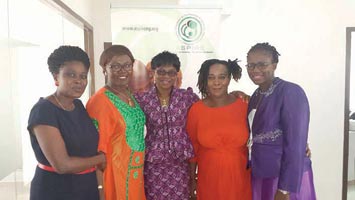
The ASPIRE team: From left : Mrs. Titilayo Aketi; Deputy Brand Ambassador; Mrs Ifeyinwa Kpajie, Brand Ambassador; Mrs Ifeoma Emekwue; Mrs. Jibor Patricia and Mrs. Ifeyinwa Okusanya
“IVF is no longer strange, yet couples are still reluctant. People who had their children in the bedroom can talk about it freely, and so should not condemn IVF because condemning it will discourage those who have had children through IVF to keep it to themselves and deny others from benefiting.”
She lamented that many women are going about trying to get pregnant, but often go to the wrong places and do not know about IVF and other ART procedures.
Emekwe stated: “What I tell couples is this: When you want to try IVF, go to a standard clinic where they will explain everything to you. Look beyond the packaging and insist on verified success rates. For instance, a good clinic should not combine fertility treatment with antenatal care. Look for testimonies of those who have patronized thee clinics and benefited.
“At every stage you’ll be carried along. Ask questions and you’ll get the right answers. Of course there are limitations and at a stage they tell you how far they can go and that the rest is up to God. Battle with purpose.
Being a married woman who has experienced infertility, Mrs Lanre Kazeem-Abimbola knows where the shoe pinches. Lanre, Secretary of ASPIRE, has had six IVF cycles and is a proud mother of two children. “Six years after marriage, I had no pregnancy. It was challenging, but after a few people I knew told me about ART, I decided to try it. I got to know about the group through The Bridge Clinic and a referral by a friend. It was not a difficult process although I experienced what is described as ovarian hyper stimulation.
“This was a battle I had to endure at every cycle I went through, but by measuring my medication. I got to appreciate the process more and was able to maximize my chances. I saved use some embryos, frozen embryos, I needed to tell the world to encourage people that this works. I had the IVF procedure six times, some did not work, but I have two children. I always had a purpose in mind and that was to have my own children. I was determined to succeed. I had seen it work for others and so, with prayers, I knew it was going to work for me as well, even when it didn’t, I didn’t lose hope. Kazeem-Abimbola who utilized her own frozen embryo for her second son said because finance is one of the biggest challenges for couples undergoing infertility, it is helpful if people have the right information. “It’s all about awareness promotion. The technology is very key, awareness is also relevant. It is all about being open minded going for assessment and that it’s out there. We need to pass the era of stigmatization, and get informed. Information is the key. Awareness is important. It’s archaic to still be thinking that infertility is a woman’s problem without actually going to find out what the problem really is. It has to go both ways. Mrs. Ifeyinwa Kpajie, the ASPIRE Deputy Brand Ambassador, has had four assisted pregnancies and one natural pregnancy, but wished she had known about IVF much earlier. “I waited eight years then got to know about the clinic and IVF through a friend. After the first cycle, I had a baby girl through IVF/ ICSI in May 2002, and then I went back a year later did another cycle and was blessed with a baby boy on May 23 2004.” Although a third attempt failed, it did not deter Kpajie who went for a fourth attempt that resulted in birth of twins (a boy and a girl) on May 7, 2007.
Natural birth after 4 IVF cycles
“When the twins were seven months old, I got pregnant naturally and gave birth to a baby girl that is now aged 7. I’m praying for God to bless others that are still looking for the fruit of the womb. If I had this knowledge earlier, if I knew what I know now about good clinics, I would not have waited this long. There are so many clinics that claim to have solution but really have nothing. They only deceive you, take your money and waste your time. If you don’t go to the right place, your problems are compounded. The main problem is going to the right place and getting the right treatment. “Eight years were wasted, if I had known earlier, I would not have waited that long. I’m part of ASPIRE to give back to society and try to put a smile on the faces of other couples looking for the miracle of childbirth”. Kpajie wants more men and women to come on board their platform in order to give back.” Let’s be enlightened that these medical procedures are here to stay and, for those who cannot afford it, let the treatments be subsidised”.
When Mrs. Ifeoluwa Oluwafolakemi Okusanya got married, her expectation, like every other bride, was to have a child as soon as possible, but it took her six years to achieve the feat.
“My own clause is that I got married to an only child and so I was under pressure to conceive quickly. By the time I got introduced to The Bridge Clinic, I had gome practically everywhere. I went for series of tests and, in the process, an abnormality was discovered.
“There were so many tests, and it was while they were trying to transfer the embryo that they found that I have two holes leading into my uterus instead of one. I was told that I was born like that and that it was not acquired. But that was what was making it difficult for me to conceive. I also had blocked fallopian tubes and they were flushed four times. If hadn’t gone for treatment, how would I have known that I had two holes in my womb? If they had not discovered the abnormality, I don’t think I would have ever got pregnant.
Fulfillment
“Today, I’m a working mother of three children. I did two IVF cycles in two years consecutively, in 2012 and 2013 which produced three children”. Okusanya had the first IVF cycle and had her first baby, a baby girl, October 7, 2012.
No regrets
Mrs Patricia Jibor who was married 10 years without any issue has no regrets whatsoever that she eventually tried IVF. Jibor told Sunday Vanguard that she had actually been pregnant naturally twice previously but lost both pregnancies. “Mine was 10 years, no issue. I had been pregnant before, but it was an ectopic pregnancy. I was so unlucky because the ectopic pregnancy ruptured
and they had to cut out one part of my fallopian tube. When the second pregnancy came, it was still the same ectopic and I was operated again. I had the operation at Military Hospital, Yaba, from where one of my doctors referred me to The Bridge Clinic with a letter. At The Bridge, Jibor was advised to have an operation for fibroid at another hospital.
“I was not cut open and, after about 2-3 weeks, I went back. I was injecting myself; so the first cycle failed. I did not give up because I had faith that it was going to work for me. I went for the second chance. The second one resulted in my baby girl.
“I have no regrets. I am fulfilled, that is why I can share my story with you, and I believe I should still have more time to talk to others who can benefit. I would like to educate and enlighten more people about availability of fertility treatment. It is to encourage those with faith to stand by their fate and not give up. First time success
After her wedding in 2002, Mrs Titilayo Aketi, waited for something to happen in the form of pregnancy and eventual childbirth, but nothing happened. “The following year, it was the same thing. It was a very serious challenge for me, because I was seeing women getting pregnant everywhere and asking myself, God, why me? What have I done?”, she narrated to Sunday Vanguard.
However, in 2004, the Aketis went to the hospital, did all the tests and discovered there was a low sperm count issue.
“We kept hoping, but it was in 2005 that IVF was introduced to us. We couldn’t afford to pay for it but God used my boss in our favour because he actually sponsored the cycle”. Before undergoing the first cycle, she urged her husband to inform the family they were going for IVF. “The first time I went to The Bridge Clinic was in September 2006. I told God that I was going to do the procedure just once and have my baby because we had no money for another cycle. I started my treatment around November 2006 and took in January and put to bed on 1st September 2007.
My twins, both boys, are a replica of my husband and their grandmother. Although I’m a newcomer to ASPIRE, the purpose is to break the silence. To make people who have benefited to come out, I have been encouraging couples with infertility challenge to take informed action. There is so much ignorance and a lot of misconceptions about IVF, including myths that children born through IVF are not normal. But that is far from truth. There is no need for any stigma and discrimination about IVF children. My children are healthy and so intelligent”.
Unfortunately, Titi lost her husband when the twins were just five months old. The boys are eight years old and in primary five.

 The UN Childrens’ Emergency Fund (UNICEF) says an estimated 1.2 million children are now in urgent need of humanitarian assistance in the Central African Republic (CAR).
 An NGO, Aids Healthcare Foundation (AHF), on Monday, said it would sensitise youths on the need to stem the prevalence of HIV/AIDS in the country.